Shri Bhuvneshwari Mahila Ashram grew out of the work of one man who arrived in Garhwal as an outsider and spent the rest of his life there. Swami Manmathan came from Kerala, learned Garhwali, and gave close to three decades to the hills — to ending a costly ritual, to winning the region its own university, and finally to building an institution for the women and children of the mountain villages.
From Kerala to the Himalaya
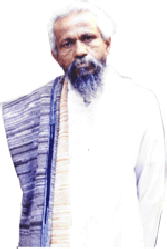
He was born on 18 June 1939 in Kerala, into a teacher's family, and named Uday Mangalam Chandrashekharan Manmathan. His formation was unusually wide-ranging for a young man of his generation: he studied in Bengal, where he was drawn to the Ramakrishna Mission and the thought of Swami Vivekananda, and later spent time in Pondicherry with the teachings of Sri Aurobindo. What emerged from those years was a conviction that spiritual life had to express itself as practical social work.
He first travelled north in the mid-1960s, reaching Rishikesh in 1965. There he was initiated by Swami Purushottamananda at the Vasishtha Cave near Gular Dogi, and took the name by which the hills would know him. He could have remained a scholar and an ascetic. Instead he walked into the villages.
Chandrabadni: ending the sacrifice
In the villages below the Chandrabadni temple he encountered the practice of animal sacrifice. His objection was not only religious but economic: for families already living close to the edge, the obligation to offer an animal was a recurring cost they could not carry. He argued the case village by village, and the decisive push came from the women of those villages, who took up the campaign themselves.
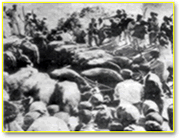
The practice was brought to an end at Chandrabadni in 1969, and in the temples around it afterwards. It is worth noting how the change was won — not by administrative order, but by persuading the community that made the offering. That method, of organising women to carry a reform themselves, is the thread that runs through everything he did later.
A university for Garhwal
By the early 1970s he had turned to a different kind of campaign. Students from Garhwal who wanted higher education had to leave the hills for it, and many simply did not go. Manmathan became one of the leading voices in the movement for a university in the region, organising public meetings across Garhwal through 1971 — including a gathering in Srinagar that drew a crowd running into the thousands — and carrying the demand to the central government.
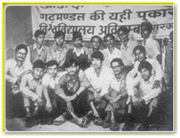
Garhwal University was established at Srinagar in 1973. For a movement led in large part by a man in his early thirties who was not from the region, it was a considerable thing to have achieved.
The Ashram at Anjanisain
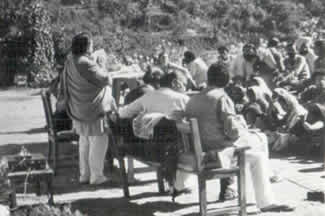
The work that would occupy the rest of his life began at Anjanisain, in Tehri Garhwal, on land given for the purpose — some ten acres — by Major Harishankar Joshi. Shri Bhuvneshwari Mahila Ashram took shape there from 1977, and was formally registered as a Society on 23 September 1978 under the Societies Registration Act, 1860.
Its purpose was specific. In a region where men left for the plains to find work and women were left to run households, fields and livestock alone, the Ashram set out to give those women skills, income and literacy of their own. The early programmes were practical ones — tailoring, animal husbandry, food processing, anganwadi and pre-school centres, adult literacy classes, and women's collectives that could hold savings and take decisions together. Branch centres followed at other locations across Garhwal.
Alongside this ran his campaigning against liquor and against untouchability, and an insistence on schooling for girls in villages where it was far from assumed.
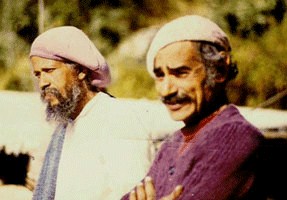
6 April 1990
On the night of 6 April 1990, Swami Manmathan was shot dead in his room at the Ashram. He was fifty. Published accounts of the circumstances differ, and no settled account of them is offered here.
The Ashram he founded continued. Nearly five decades after the first work at Anjanisain, SBMA still runs programmes in early childhood care, education, women's livelihoods, health and environment across Uttarakhand — and the pattern he set, of organising women to carry the change themselves, remains recognisable in the way that work is done.
From the Ashram archive
Photographs from SBMA’s own archive, spanning the Ashram’s early decades. They are undated and uncaptioned in the records that survive; anyone who can identify the people, places or occasions in them is warmly invited to write in, and the details will be added here.
Photograph